日期:2026-10-29 浏览:6作者:UoM China Centre
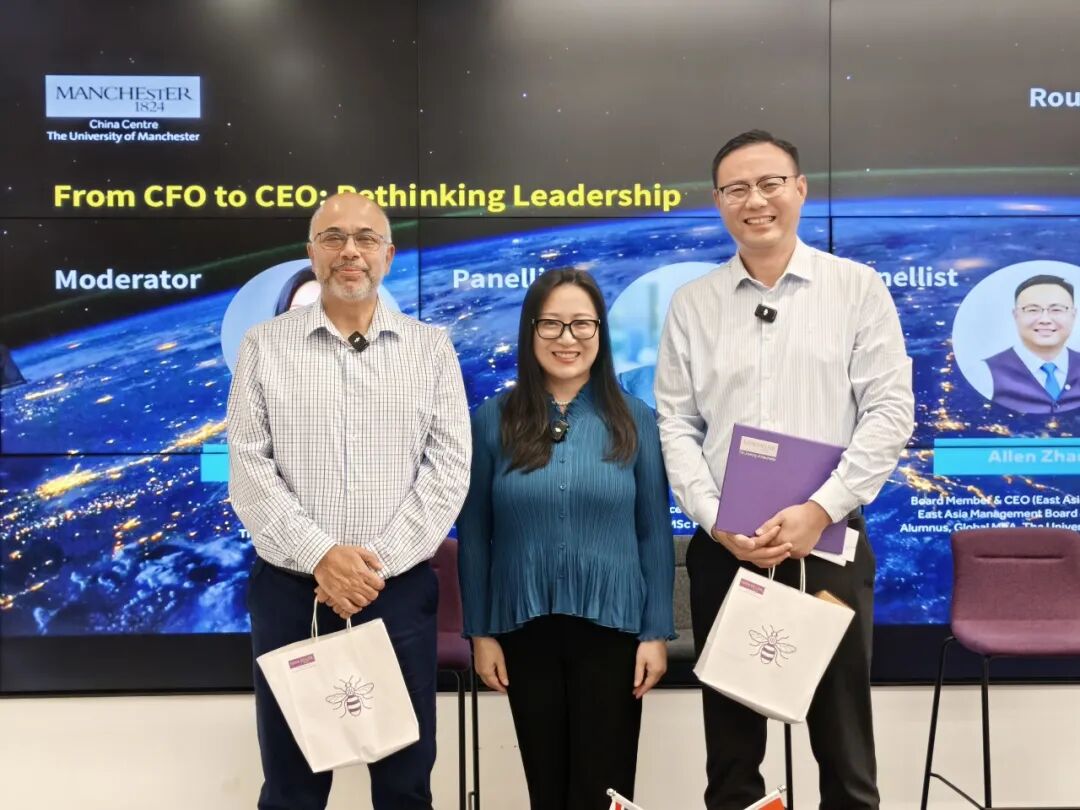
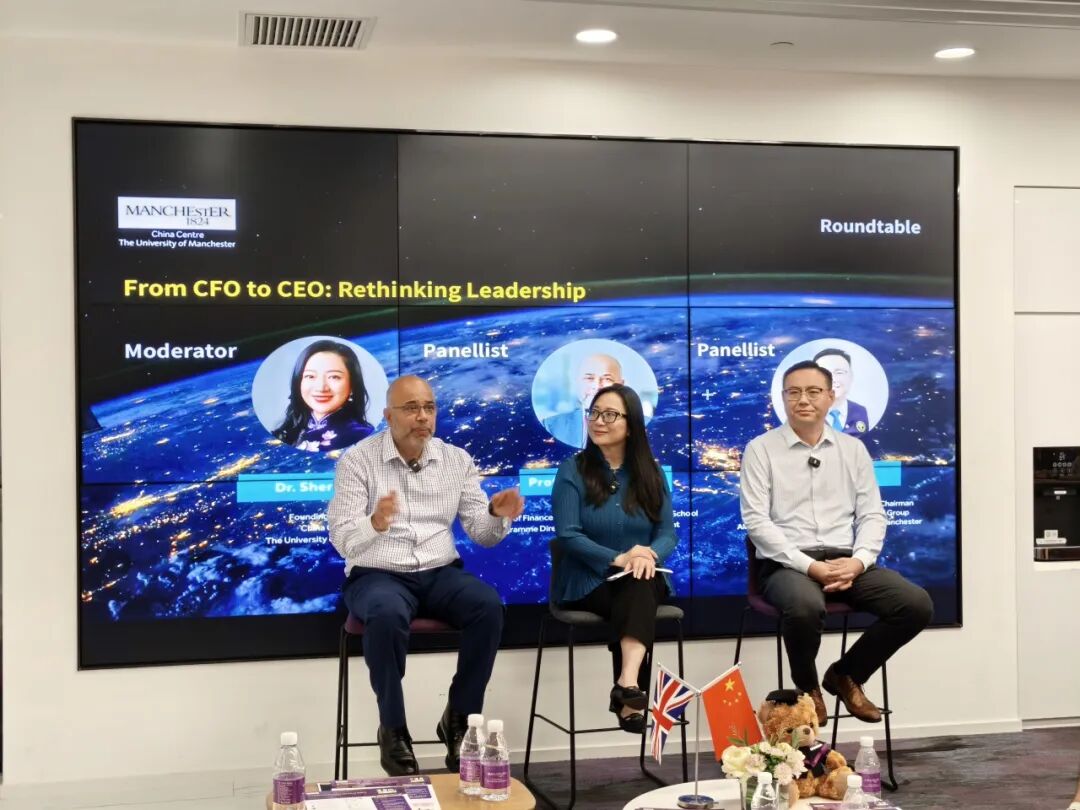
On the evening of 19 September, The University of Manchester China Centre in Shanghai hosted a masterclass and a roundtable conversation. Arif Khurshed, Professor of Finance at Alliance Manchester Business School and Programme Director of the MSc Financial Management, spoke on "Inside China's IPO Market: Insights for Entrepreneurs and Investors". He was then joined in conversation by Allen Zhang, a Manchester Global MBA alumnus and CEO of Wanzl Group's East Asia region, on the theme "From CFO to CEO: Rethinking Leadership". The session was chaired by Dr Sherry Fu, Founding Director of The University of Manchester China Centre.
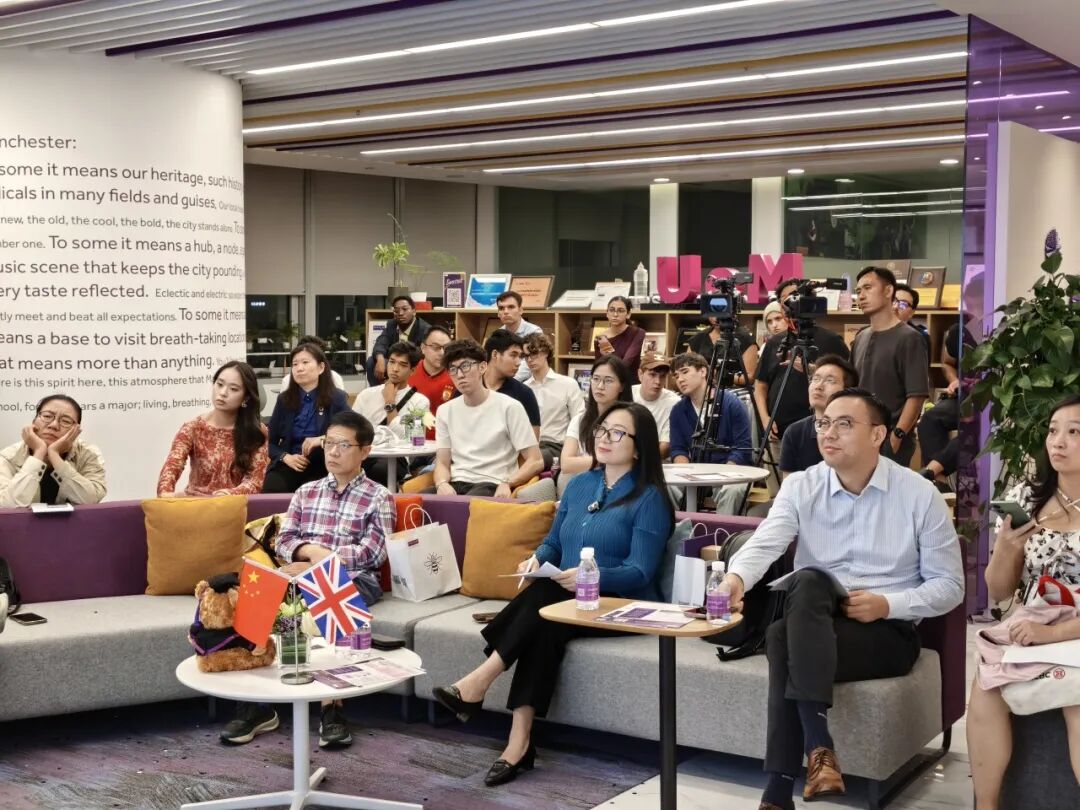
Attendees came from countries and regions including China, the Netherlands, Russia, Kazakhstan, and Morocco, with backgrounds spanning finance, investment, and management, as well as younger professionals considering a part-time master's programme.
Professor Khurshed opened with the simplest version. You founded a company, you have run it for ten years, and now you have bigger plans that need a few million, or several hundred million, in funding. The banks are reluctant to lend more, and venture capital has already had its round. So where does the money come from?
One answer is to go to a stock exchange and sell shares to new investors. That is an IPO, an initial public offering.
Raising money is not the only reason to list, though. Some IPOs are used to repay debt taken on in earlier years and cut the interest bill. Others let founders and early shareholders turn their shares into cash, which is what he means by liquidity. And in some cases a government sells down its holding in a state-owned company step by step; he calls these privatisation IPOs, and PetroChina, Bank of China, ICBC and Saudi Aramco all belong to that group.
The two ends of the same market are counting different things. For the company, a listing means ammunition for expansion. For the investor, it is an entry point with remarkably attractive short-term returns. Everything that follows in the session is seen from the second of those two vantage points.
Professor Khurshed cited KPMG's figures: in the first half of 2026, 79 companies completed IPOs on the A-share market, 30% more than in the first half of 2025, raising a total of RMB 100.5 billion, up 87% year on year. The ten largest deals accounted for 46% of all proceeds.
What those numbers show is that China has become one of the most active markets on the global IPO map. By funds raised so far this year, Nasdaq ranks first, Hong Kong second, the New York Stock Exchange third and Shanghai fourth. By sector, technology, media and telecom, along with industrials and real estate, all appear among this year's listings.
It was the next set of figures, though, that quietened the room. In the first half of 2026, A-share IPOs delivered an average first-day return of 233%, and none closed below their offer price. Over the same period, the Shanghai Composite Index rose 3.46%.
Same market, same six months: more than 200 percentage points on one side, just over three on the other. That gap is the starting point for every piece of advice that follows.
An IPO is not something a company decides on one morning. Professor Khurshed pointed out that from the moment an internal consensus forms, a long list of parties has to be brought in. The central one is the sponsor, usually an investment bank, which handles underwriting, valuation and issuance. Around it sit the legal team, accountants, auditors, media agents and the share registrar. None of these professional services come cheap.
One document deserves a close read from ordinary investors: the prospectus. It is a legal document that sets out the company's history, its reasons for listing, the number and price of the shares on offer, the ownership structure and its future plans. It is the company's formal channel for speaking to the outside world, and the primary material on which investors form a judgement.
The pace picks up sharply in the later stages. Pricing is settled about a week before listing, when the company decides at what price it will sell shares to new investors. Allocations are usually announced a day or two before listing. Then come the roadshow and bookbuilding, when the company meets investors in different cities and asks how many shares they would buy, and at what price. Only then does listing day arrive.
He took a semiconductor company that listed on the STAR Market this year as his example. It cleared the listing committee review on 24 February, completed CSRC registration in early April, ran its roadshow and bookbuilding from 7 April, completed allocation and published its prospectus between 11 and 13 April, and traded for the first time on 21 April. The offer price was RMB 19.68, and it closed its first day at RMB 76.65.
From pricing to the bell, a company travels much further than most people imagine; from offer price to first-day close, an investor waits a single trading day. Put the two together, and you have the whole tension of China's new-listing market.
Draw the regulatory framework and it is not complicated. Chinese mainland has three stock exchanges. The Shanghai Stock Exchange is the largest, home to big established companies and state-owned enterprises, and it hosts the STAR Market for science and technology innovation companies. The Shenzhen Stock Exchange serves high-tech and emerging growth industries, with a main board and a ChiNext board modelled on Nasdaq. The Beijing Stock Exchange is the newest and serves innovative small and medium-sized enterprises.
There are two levels of supervision: the China Securities Regulatory Commission, the market's principal regulator, and the exchanges, together with the National Equities Exchange and Quotations (NEEQ).
He described the changes of the past decade and more as "a great deal of work by the regulators". For a long time China's IPO market ran an approval-based system, in which the regulator largely decided when a company could issue and at what price. The market paused altogether in 2012 and 2013, with no new listings at all. New rules gradually returned pricing power to the market, and once the registration-based system took hold, the pace of issuance accelerated noticeably. The activity of 2026 is the result of that round of reform.
A large first-day jump has a name internationally: underpricing. Investors subscribe at the offer price, the shares leap to a higher price on the first day of trading, and the difference is the return.
By global standards China's underpricing is extreme. From January to June, A-share IPOs returned 233% on average on the first day, and for years the market has held between 200% and 250%. In London first-day gains typically run at 15% to 20%; Russia has virtually no underpricing; Greece sits between 40% and 50%; the United States and the United Kingdom fall in the middle. The UAE and Saudi Arabia have been moving closer to China in recent years, but a gap remains.
The problem is that a high first-day return is not the same as a good long-term investment. Professor Khurshed's research, and a large body of literature, points to the same conclusion: over the three to five years after listing, IPOs underperform the market, by anywhere from 10% to 50%. In Brazil the average decline over three years is about a quarter; in India close to 60%; in the United States and the United Kingdom it is between 12% and 20%.
His example was China Telecom. It listed in August 2021 at an offer price of RMB 4.53, and by the end of 2023 the shares were still below that price, having trailed the wider market through their first two years. This is not an isolated case but a pattern that holds across markets.
The reasons are not fully understood. He readily admitted that the stronger a company's profits before listing, the worse it has tended to perform afterwards: "we are still looking for the answer to that one". For ordinary investors, the practical implication is clear. With a new listing, you are earning the first day, not the holding itself.
In a session that ran for more than two hours, Professor Khurshed compressed 25 years of research into a working checklist.
He also flagged something specific to China: demand far outstrips supply. A company issuing one million shares may face subscriptions for ten million, or ten times oversubscribed. Allocation is therefore decided by lottery, and even a successful applicant may receive only a limited number of shares.
For ordinary retail investors the bar to entry is low. You need an account with a licensed broker and a bank account for the money; nothing has to be paid up front, and funds are frozen only once you win an allocation. He noted in particular that, unlike London, China allows retail investors into IPOs, which is by no means common around the world.
The roundtable was chaired by Dr Sherry Fu. Her introductions of the two guests were apt: one "the star of the School", the other "the local star".
Allen Zhang's connection with Manchester began in 2018, when he was finance director at a German family-owned company. His daily work was numbers and performance reports, helping the China general manager and the global chief operating officer reach decisions. Two years later he joined Wanzl Group as chief financial officer, and in 2021 he graduated from the Global MBA. Because of the pandemic the graduation ceremony could not be held in Manchester and moved to Shanghai instead; he calls the time he spent with his classmates that year "a memory I will never forget".
The change came last September. The group's executive board decided on a new arrangement for China, combining the Northeast Asia and South Asia markets into a regional management structure. For the previous twenty years the role had been held by a European general manager. The new candidate had to go through more than five rounds of interviews at different levels, and Allen Zhang was ultimately nominated as CEO of Wanzl Group's East Asia region and Chairman of the East Asia Management Board.
Asked which course genuinely changed him, he did not name a finance course but the Strategy & Innovation course. "In that classroom I learned game theory, how to be a value player, how to be a low-cost player, and I learned about differentiation." The course, he said, moved his leadership from transactional to transformational: away from watching results and performance, towards aligning strategic thinking with the German management team and putting ideas into practice.
He also described a team project in the digital marketing course. The group had to put together a proposal for an STP strategy, for Tesla. "We are obviously not as expert as Musk, but we could at least contribute some ideas." In the group were classmates from SAIC, a colleague from Luckin when it was still just getting started, and someone from Volvo, while his own background was in mechanical manufacturing. To verify a single data source, the whole team stayed up late to check the conclusion. He said he took two things from the experience: the difference between induction and deduction, and that "you cannot just be a bystander".
An audience member asked how to choose between the MSc Financial Management and the Global MBA. Professor Khurshed directs the former and also teaches on the MBA, and his answer was direct.
Before the professor answered, Dr Sherry Fu added an observation from her interviews with applicants. Most people who come to the MBA come from a functional line: finance directors, finance managers, marketing managers. But the MBA is not designed to turn them into finance managers or marketing directors. It provides a general management toolkit and moves people from questions like "what is the return on this programme" towards "what do I want this company to become, and where should it go in the next five years". "From CFO to CEO, from CMO to CEO, what actually turns is the way you ask the question."
If you want to become a specialist in finance, the MSc Financial Management is worth considering even if your first degree was not in finance; if you care more about how a company is managed as a whole, the Global MBA is the better fit. He does not see one as above the other: "this is a question of choice, and you decide what drives you."
As the person who designed the MSc Financial Management, the professor also explained his thinking at the time. Around 2016 the Dean of the Business School asked him what he would build if he could design a programme from scratch. His answer rested on three principles: solid technical training, applying knowledge in practice, and making sound decisions. Behind the third sat a more specific aim, giving people the ability to make decisions when information is incomplete.
"If all the information is there, deciding is easy. In reality it usually is not." That, he said, is what makes an IPO such a good teaching case. Before listing, companies weigh valuation, timing and who will buy the shares over and over, while often overlooking other questions: whether the company is ready for external scrutiny, how a listing will help it grow, and what employees will think when they hear the company is going public.
The Global MBA, in his view, is a different design, what he calls a reflective MBA. The programme sets out theory and models first, then throws in real problems from companies and sends students off in teams to find answers. Discussion, argument, agreement, a presentation two days later: the process itself is the assignment.
To close the roundtable, Dr Sherry Fu asked each guest for one piece of advice for the young professionals and international students in the room.
Professor Khurshed said the world is now changing faster than jobs themselves, with climate, information and AI all reshaping industries. "Invest in yourself, become a critical thinker, be someone who learns deeply." It is, he stressed, the only investment whose value lies entirely in your own hands, and the earlier you start, the sooner it pays back.
Allen Zhang offered a line in English: think big, do small. When you are still small, he explained, you go with the trend. In the year he enrolled, more than two thousand MBAs were graduating in Shanghai every year, and what makes someone stand out is not the qualification itself but differentiation. "If I had a second chance, I would make the same choice."
 |
||||
|
Prof. Arif Khurshed Professor of Finance, AMBS Programme Director, MSc Financial Management |
||||
|



 EN

